
Blog, November 2026
5 AI Questions Patients Should Ask
With the growing presence of artificial intelligence (AI) in our everyday lives, it’s overwhelming to figure out what’s noise and what’s valuable. From personal uses to business, there are many ways AI is supporting people. In 2019, before the AI boom, Dr. Google was my only tool and I often found myself searching and revealing terrifying information because I was asking the wrong questions. Today the tools and technology with AI are much better, but you need to understand how to leverage them. I’ll explain what these types of questions could look like and the impact they could have.
When we use LLM (large language model) tools like ChatGPT, Claude or Gemini, we need to give context within the prompt. These should be in the form of sentences, explaining the context, role and constraints. Prompts are entered in the main text box that appears on the page (see image below).
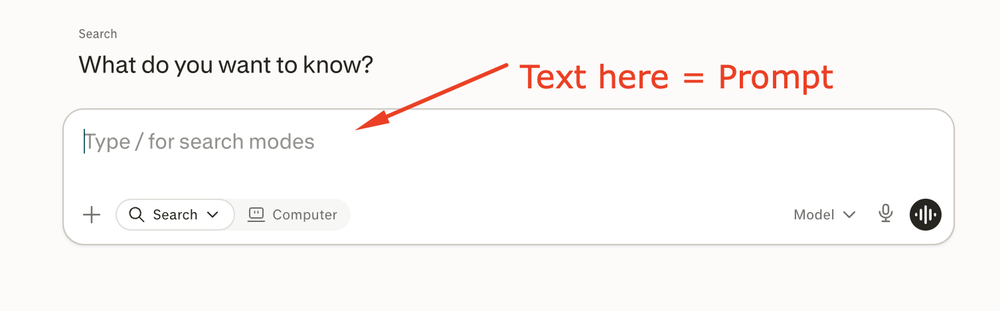
The reason for prompts being structured with strong context is the answers and outputs depend on what you feed in. Think of it as garbage in = garbage out. Unlike traditional search on Google, where we entered short tail keywords or phrases, the opposite holds true when trying to fetch answers within the LLMs. A best practice that I’ve mentioned in previous articles is “prompting the prompt”. This means if you’re completely unsure of how to formulate a good prompt, start asking the questions within that text box on how to create this for you. For example, if I was completely unsure how I should be setting up a good prompt to understand heart disease, I could start by asking the tool this exact question:
I am trying to create a prompt to give me the best information about heart disease. I need help.
Understanding basic prompting within the LLM tools is the first step to taking advantage of this great technology. It’s critical that we ask the right questions within these tools to get the best answer possible. So what other questions should patients ask when using AI? Before I get into my top 5 suggestions on how it’s helped me, I need to be clear that there are different comfort levels with people when it comes to entering any information about themselves or their health. Some are fine putting in lab records, imaging and health consult notes, while others are completely against it. In my experience, I have found it helpful on complicated blood work and consult notes to help me explain things I didn’t have a chance to ask my doctor about. If that isn’t you, that’s OK. AI can still help you with general education around disease awareness and research. Here are some of the top questions I’ve found helpful as a patient:
Q1: I was diagnosed with {condition} in {year}. Explain it in plain language, how it typically progresses, and the five questions you’d want answered if this were your diagnosis.
When I was told I had CVID, I had little time to fully comprehend what that meant when the news was being given. I’ve spoken in the past about how it didn’t really hit me until I was already sitting in my car ready to leave, when dozens of questions flooded my brain. Now, you could use AI to get laser-focused answers on your diagnosis by looking into the clinical studies, the medication options, the adverse event reporting and patient advocacy groups, and come prepared with a set list of questions for your next appointment with your doctor after doing this due diligence.
Q2: Here are my {test} results from the last {number} rounds. Explain what each flagged marker means for {condition}, and tell me what the trend shows over time.
Within my disease, I get blood work to check my IgG levels every 6 months, but there’s also a number of other blood markers being tested. I try to understand as much as I can but the medical jargon is complex. This is where I will either ask AI or crop out sections of the lab tests to help me understand what specifically is being tested, what it means within my particular disease, and what can be done to improve it. Usually, I’ll start by looking at anything that is being flagged and shown outside of the normal reference range. From there, I like to keep records and feed AI these lab reports to see the trends.
Q3: I have {condition} and I’m currently on {treatment}. What other approved treatment options exist, how do they differ in dosing and side effects, and where is each available?
People often assume what they are given is the only option that exists. Oftentimes that isn’t the case, and I have my own experience as an example. When I was given weekly sub-q infusions, I couldn’t stand the duration and some of the adverse events that came with it. Because of my pharmaceutical background, I was always close to the drug manufacturers and their pipelines for innovative medicines, especially the advancements in rare disease. What I found was a much better product (for me), which I brought to my specialist. It changed my dosing to monthly infusions at 45 minutes and completely altered my quality of life, simply because I had taken the initiative to not be satisfied with the status quo given to me. My point is, using AI to search for other alternatives and to educate yourself is smart. I’m not suggesting self-prescribing, but don’t assume there aren’t other options available you can at least bring up to discuss with your doctor.
Q4: Using everything above, write the ten most important questions I should ask my {specialist} at my next appointment. Rank them, and tell me which three matter most.
If you’re like me and want to make the absolute most of your time at your doctor appointments, going in prepared has never been easier with AI. Using the LLMs to surface any gaps around your diagnosis, disease or current therapies is one place to start. Further, keeping notes on your current labs and imaging may also be helpful to get clarity. I’ve found AI extremely helpful in taking prior consult notes, labs and any new information I’ve researched and turning them into a condensed set of questions that I can print out and come prepared to get answered.
Q5: Help me write the prompt for this.
This goes back to what we discussed above on “prompting the prompt”. Asking AI to help you write out the prompt around your topic or question will be the easiest way to leverage this technology. The examples are countless because it can be used to accomplish whatever it is you are trying to unlock with AI. If there’s one thing you walk away with from this article, using AI to write the prompt for you would be it.
AI won’t replace your doctor, and it won’t diagnose you. But you are the only constant across every doctor, nurse and health care provider across all institutions. If you’re looking to level up how you show up, prepared, educated, informed and asking better questions, the tools available have never been better to advocate for your health. Use them.
This article shares one patient’s experience and general information. It isn’t medical advice. Talk to your health care team about your own care.